The road to Ferrara was to be a long one...120 km.
We left early on a Sunday morning to avoid the traffic on a very busy highway. We were told no semi's were allowed on the road until late Sunday evening. What we experienced was a reminder that in Italy what's allowed and what actually happens rarely resemble one another. The first vehicle to pass us---and almost blow us off the road---was a semi with tandem trailers. For the most part however, our first 25km weren't all that bad. At that point we got off the main road and onto a strada provinciale (a provincial road, which are typically without trucks and not a lot of traffic at all.)

The road was flat, much of it (80km) along a bike path built atop the levee of the River Po. About 12 years ago Destra Po (right side of the Po) was developed for biking and walking along the river. It is part of a national park. Of course, if there is a Destra Po, there is also a Sinestra Po (Left side.) You guessed it. We weren't smart enough to figure out there would be TWO bike paths where we got on - which was of course also the only place you could get on one or the other and after the sign indicating such. We got on Sinestra Po and rode about 7km towards Venice, to the north, before meeting a young couple out for a Sunday ride. When we asked them about places for lunch up the trail, they informed us we were on the wrong trail! Surprise, surprise. We rode back with them to where the trail split, the correct trail going over a bridge at that point. They were very nice, and it was about the first time we had seen a young couple riding together. Very few woman are out here on anything other than city bikes for grocery shopping, etc.
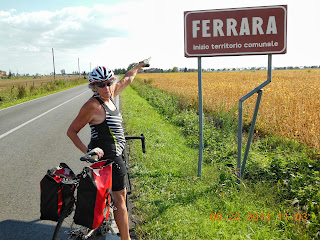 |
| Commune of Ferrara, not the city, which we entered about 5km further up the road. |
It felt nice to get to our destination.
Ah, Ferrara. We were last here 13 years ago. The city has changed dramatically, and while not to our taste, the local folks are most likely very happy with the "upgraded" ambience.
 |
Our studio apartment was in a renovated 12th
century castle.
|
 |
| A typical street |
 |
| Another typical street |

The medieval city of Ferrara was protected by a surrounding wall...most of which is intact...and can be walked on today. We walked a LONG way on the wall one afternoon to visit a ceramica, a factory where ceramics are made in the traditional style of the 14-1600s. We bought one piece of theirs when here last, and it is one of our favorite pieces.
Never has there been a city dominated by one family like Ferrara. The Dukes of Estes ruled Ferrara for hundreds of years. They left their imprint on everything. The Castello Estanse dominates the old city (We visited the Castello 13 years ago, and Carol had me thrown in the dungeon):
 |
| Este Castle, right smack in the middle of the old city. |
We tried to find a single palazzo or church that did not bear the Este name.
 |
| Diamonti Castle. There are over 7000 pyramid-shaped stones on the front of the castle. |
Those few that didn't turned out to have been built by Este nephews or in-laws.
The Estes were remarkable because they exerted influence throughout Italy totally out of proportion with their power base. They managed to pull this off by waiting until the big power players deadlocked and then threw their support to the winning side...for a price.
They were also very good businessmen. Early on, one of the Este dukes needed money and so invited some impoverished Jews to his city to act as money-lenders. The Jews became prosperous, and the city thrived along with them...developing one of the first capitalist economies in Europe. A good read that partially takes place in Ferrara and is about Spanish Jews forced to flee is The Secret Book of Grazia dei Rossi.
 |
| A street in the old ghetto. |
In 1492, when Ferdinand and Isabella expelled the Jews from Spain, Ercole d' Este invited them to Ferrara. A good number came...giving the economy and the community a shot in the arm.
 |
| Carol at the old "Spanish" synagogue. |
The plaque at the Spanish synagogue telling the story of the Estes' invitation of the Jews to Ferrara.
UNESCO named the Ferrara ghetto a World Heritage site. The community grew and prospered until 1944, when the Nazi's shipped much of the population off to concentration camps. Ad, speaking of books and authors, that story was made famous in the novel and movie, "In the Garden of the Finzi Contini." Giorgio Bassani wrote a number of other novels and short stories, all taking place in Ferrara. The author of that novel was born in Ferrara in this house. It is across town from the ghetto.
 |
| Bassani's house, with a plaque telling who he was and that he lived here. |
Look who visited the University!
Below is a photo of one of the Estes, at the entrance to the Piazza del Popolo (Piazza of the people.) When it was last renovated, the column was made from tombstones taken from the Jewish cemetery.
...and at the end of the day...
 |
| The end of Roger's "work" day |
 |
| The statue |
 |
| The sign that says that in 1927 when the statue was redone, its base was made from tombstones in the Jewish cemetery. |
When last there, Ferrara felt like a small town, even with a substantial tourist population.


