Monday, December 2, 2013

The End of An Era

(Sorry for the delay on this post.  Internet access was spotty last week.)
The middle of last week, the Italian Senate expelled prime minister Silvio Berlusconi…the leading figure in Italian politics for the past two decades.

Berlusconi was not just another politician.  He completely re-shaped the Italian political environment.  Before he first became Prime Minister, Italian politics were dominated by the center-right Christian Democrats and the center-left Social Democrats.  Today, neither party exists.


He created his own party. Forza Italia (Strong Italy).  It formed coalitions with other right-wing parties such Lega di Nord (Northern League) to oppose immigration (sound familiar?).  During his last election…when Italy was at risk of defaulting on its debt…he opposed the sale of the government-owned Al Italia Airline (which is hemorraging money)  saying it would be an affront to the nation’s pride.

Berlusconi’s rule was dominated by a series of scandals.  He got a former girlfriend…reputed to be a call-girl…elected to Parliament, then appointed her to a cabinet post.  When the scandals got too close for comfort, his cronies passed laws exempting him from prosecution.

The straw that broke the camel’s back involved a party…some called it an orgy…where Berlusconi had sex with a 14 year-old Tunisian girl.  That prompted an investigation that ultimately led to his conviction for tax fraud.

Italian law is clear.  Convicted felons are not allowed to serve in Parliament.  For anybody else, removal from office would be a mere formality.  In Berlusconi’s case, it was a months-long soap opera.

This whole affair reminded us of the downfall of Richard Nixon.  First, it took two years to complete.  It involved exhaustive investigations and publicly-televised parliamentary hearings.  Berlusconi never addressed the issue of his guilt;  instead, he mounted a counter-attack, accusing his political opponents of trying to hijack Italian democracy.  And finally, he is the only person…much less a politician…we have ever seen who has the same body language as Nixon.

The media, of course, had a field-day with the story.  Italian newspapers are very ideological.  They make no attempt to confine their political opinions to the editorial pages.  The headlines demonstrate the point.

La Repubblica, the paper that lead the assault on Berlusconi, reported:


"Berlusconi, the leader has fallen."


“The Senate Votes to Expel Berlusconi.” then quotes him as saying, “I will not withdraw to a convent.”


“Berlusconi Falls.  He will fight on.”


“Berlusconi out of Senate”  he says, “Today is bitter.  I mourn for democracy.”


News-stands usually post sandwich-boards out front with headlines from the papers they sell.


This headline screamed, “The state sells the Parliament to the Mafia.”


La Nazione is the leading conservative newspaper and has been a staunch defender of Berlusconi.


The headlines read (more or less), “Berlusconi has fallen but he remains…Women of Forza Italia dressed in mourning…his followers said, “It’s a shame for democracy.”


On page 3 the headlines read...


“Berlusconi out of Parliament…Chaos in Parliament Hall…A severe blow to the nation.”


Fortunately, one national newspaper had its priorities straight…

The people we know here in Pienza…regardless of political affiliation…simply heaved a sigh of relief that it was finally over.

But is it?  The President of Italy said he would consider a pardon…if Berlusconi asks.  Berlusconi plainly said he deserves a pardon and shouldn’t have to ask.


Sunday, November 17, 2013

Olive Oil


Tuscans say they produce possibly the best wine in the world but undoubtedly the best olive oil. 

This is the time of year for the olive harvest.  The fruit is ripening on the trees.

Please understand, we not talking eating olives.  In fact, these olives are so bitter they’re impossible to eat (we tried).  Nor are we talking cooking oil.  You can use Sicilian or even North African olives for that.

We’re talking the olive oil you use as a seasoning for cooked foods and for raw vegetables...think sauces, soups, baked goods or salad dressing.


The Harvest


Olives are not harvested like other fruit.  The olive grower first spreads large nets around the base of the tree.

Then they use one of two methods to get the fruit off the tree.


The most modern method shakes the olives off the branches using a machine that looks like a motorized pitchfork at the end of a long pole.


The pitchfork vibrates aggressively, and the ripe olives tumble from the branches into the nets.


With mechanical tree-shaking, more than olives fall into the nets.  The nets are covered with leaves, small branches, and stems as well.


All this waste must be separated out and disposed of...which takes time.

The second harvesting method is more old fashioned.  Just climb a ladder or the tree itself and strip the fruit off the branches by hand.


This is our neighbor Giuseppe.  He prefers the old-fashioned way.  He has a point.

Stripping the fruit off the trees by hand damages the trees less that the mechanical shakers.

There is also much less time spent sorting... since what falls into the nets is olives without most of the twigs, leaves, and stems.


In the end, it takes roughly the same amount of time either way to get all the fruit off a tree and into baskets.


Giuseppe talked Carol into helping out a bit.


The learning curve on how to pick olives by hand is short and not very steep.


Picking olives is labor-intensive, no matter how you do it.  Roger and three others spent three hours harvesting the olives from just two trees.  A healthy olive tree will produce roughly 4 liters of finished oil.  Now you know why good olive oil is so expensive.


The work can also be hazardous.


You’re high up in a tree.  The orchards are often on steep hillsides where the ground is not level.  And the ripest bunch 
of olives is usually just out of reach...


But the work gets done.  The baskets of olives slowly accumulate...


...until there’s finally enough to take to the press.


The olive harvest runs from early November through late-December.


Fruit that’s picked early tends to be green and not as plump.

Round black olives...like the ones to the left... yield the most oil.  

However, the highest quality, best-tasting oil comes from green fruit.  


So the question is when to pick...

The olives need to be processed within three days of harvest, or they start to dry out.


The Press


When we visited the processing plant, we weren’t sure what to expect.  The old press outside the plant showed us the way it used to be done.


Here we have to stop for a minute to explain some terms.  On olive oil in stores, you’ve probably seen the terms “extra virgin” and “cold pressed” on the label.  These explain how olives are turned into oil.


It is possible to get more oil out of an olive if you do two things to it.  After the first press, you’re left with a mass of pulp.  If you heat the pulp or press it again, you can squeeze more juice out of what you have.  However, the heat alters the taste (not for the better) and the second or third press produces lower quality oil.  Therefore, “extra virgin” oil refers to the product from the first press and “cold pressed” means the fruit was not heated before processing.

With that in mind, we walked into the Fregoli processing plant and were surprised by what we saw.


...a thoroughly modern food processing plant, designed to process 4,000 metric tons of olives per day.  It was a good thing, because there were lots of olives waiting.


The olives are processed in batches, with each grower’s fruit run as a separate batch.

This plant runs 24 hours a day, seven days a week from early November through late December.


What came in that day got processed that day.


The olives were stored in big tubs...

...each one holding from 500 kg to a metric ton of olives.


The process starts with each batch getting weighed....


...which is how Fregoli knows how much to charge the grower.  


This batch weighed 564 kg (nearly 1,250 lbs).  

It produced about 55 liters of oil.


Once they’re weighed, the processing starts.  


The fruit goes on a conveyor through a wind tunnel that separates any leaves, twigs or loose stems from the heavier olives.


The olives are washed for an hour...


Then mechanically crushed into a thick pulp.  The heavier pits are separated out.

That pulp is mixed with water for another hour.


The cliche “oil and water don’t mix” applies here.  Gravity separates the two.

The pulp that’s left over is dried out and then used as biofuel to power the plant.


Finally, olive oil emerges from the complex of stainless steel pipes and tubes...


The oil is then pumped into large containers...


...and taken home to be bottled.


Paolo Fregoli has been doing this for years...as has his family before him.


The growers call him <<Il Capo>>... The Boss.


Bottling

The premium olive oil business in this part of Italy follows the same pattern as the Brunello wineries.  There are no giant food conglomerates mass-marketing their products world-wide.  Instead, there are hundreds...perhaps of thousands...of small growers who produce a few thousand liters of oil each.

Enter Franco Bardi.

He runs a small family operation between the villages of Petroio and Castelmuzio.


A professional olive oil grader told me his oil is among “the best of the best.”

What makes his oil so good?  


He says it’s the soil and the local micro-climate...just like fine wine.


Bardi produces only four thousand bottles of oil a year.  He ships world wide.  The day we visited he was packaging for a shipment to Tokyo, and another pallet destined for Hong Kong was sitting on his loading dock.

His oil is award-winning...


...and his label is protected by a powerful producers’ association.

Which brings us back to the olive oil grader.

Carlo Moricciani is a professional olive oil taster.  The oil first goes through scientific chemical analysis and only then, if it has less than .05% acidity, it is tasted by Carlo or one of his collegues in a blind taste test.  If it is part of the approximately 80% which meets his palette’s approval, it gets the stamp of  Olio d’Olivo di Toscano.  


...and Franco Bardi can put this stamp on his label.


If it doesn’t pass, it can still be bottled and sold, but the word “Toscano” cannot appear on the label.


Friday, November 15, 2013

Fall Colors...A New Meaning


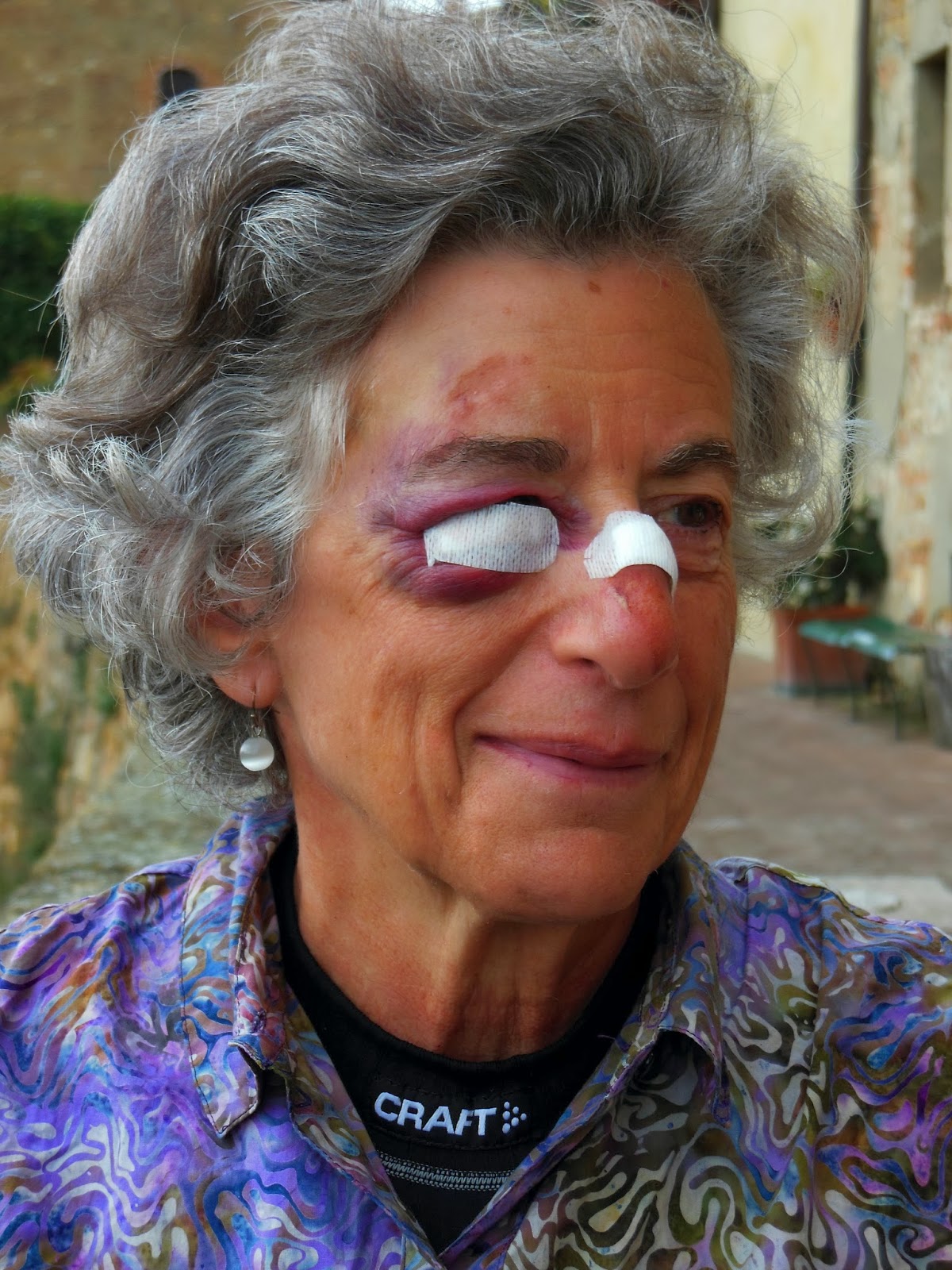
This give a new meaning to the phrase “Fall Colors.”

Carol took a tumble yesterday---slipped on some wet leaves while walking to purchase more cell phone minutes---and hit her head on a stone wall.


She got a stitch under her eye and a butterfly bandage to close a cut on her nose but is otherwise OK.


By today, she was looking much better.  Her motto has become, <<Quando lotta con una mura, sempre se persa>>  (not sure of the grammar, but, “If you battle a wall, you always lose.”)

By the way, after her fall, she got an ambulance ride to the nearest hospital (20 km away), an ER visit, stitches, and a CT scan.  The bill came to...  

...$168 (US).

Cudos to the Italian health care system.

PS:  Good thing half or her face is Carol’s favorite color, as it matches available wardrobe.  Would not want to be <<senza modo>> (“without fashion”) in Italy.