Wednesday, October 28, 2015

The Family Piccolomini

We have known for years that our town of Pienza is named for Pope Pius II.  He imagined, had designed, and ordered construction of Pienza as the world's first planned city.

We also knew that before he became Pope, Pius II was known as Enea Silvio Piccolomini.


We knew the Piccolomini family had been local nobility in the Val d'Orcia back to the time Pienza was known as Corsignano.


We figured it was time to learn more about the family.

At the right is the Piccolomini coat of arms.  It will play a prominent role in our quest for more of the family history.

First record of the Piccolomini family comes from the year 1220, when the Holy Roman Emperor gave a grant of land in the Val d'Orcia to the family as a reward for loyal service.  This loyalty to the emperor would shape the family's history for the next 300 years.

As the Renaissance dragged the Italian economy from feudal to modern, friction developed between the new merchant class (known as the Guelphs...who supported the Popes) and the landed aristocrats (known as the Ghibelline...who backed the Holy Roman Emperor).  This friction erupted into a full-scale civil war in Tuscany that lasted 150 years.


By the year 1400, the Piccolomini's were well established in Siena as well as the Val d'Orcia.

There are signs of it around the old city.


When her became pope, Pius II built a large palazzo just a three-minute walk from the Campo (Siena's Main piazza...pictured above).


Today that palazzo houses, among other things, a pizzeria named "Below the House of the Pope."


The fortunes of the Piccolomini family waxed and waned along with their Ghibelline allies all through the long civil war.  Three times they were run out of Siena, only to return when their faction regained power.


By looking carefully for the family coat of arms, you can see where in Siena the Piccolomini family exerted influence.  In the case of the crest at the left, it's on a building that now houses a sporting goods retailer.


More impressive is their crest on this building...corporate headquarters of the Banca Monte dei Paschi di Siena.


The bank was founded in 1472, making it the world's oldest functioning bank, and one of Italy's largest.


Just below the bottom row of windows are the family crests of the founders...the Piccolomini coat of arms prominent among them.


Over the years, the family produced its share of notables: two popes, a cardinal, head of the Jesuits, an astronomer who discovered craters on the moon, and the patron of Galileo Galilei.


The Siena Cathedral is no doubt the city's most grandiose building.


The Cathedral dates back to 1215.  The large front doors (that's Carol standing in front of them) are that tall because mounted knights, armed with their lances, could enter the Cathedral to be blessed before heading off to war.


The marble of the interior is set in black and white stripes, the colors of the city.  It contains sculptures by Michelangelo, Bernini, and Donatello.


It also contains a lasting tribute to the Piccolomini family.


In a prominent position just to the left of the Cathedral's apse, is a monument to Pope Pio II, the builder of Pienza.

Across the nave is a similar statue of his nephew, who became Pope Pius III.
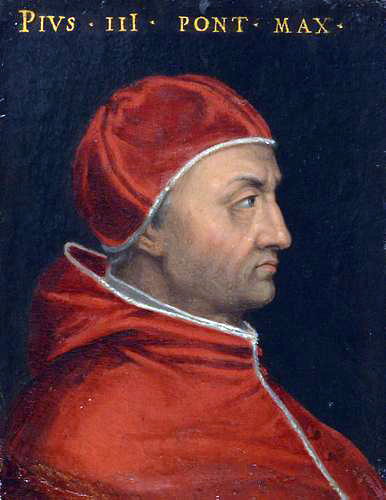

Pius III is an interesting footnote in the history of the Papacy.

In 1503, when the first Borgia Pope, Alexander VI died, The College of Cardinals deadlocked when voting for his successor.  Neither the supporters of the Borgias nor the supporters of the Rovere family could muster a majority.  As a compromise, the College selected Francesco Piccolomini, an ailing but well-respected member of the Papal Curia.  Francesco chose the name Pius III, out of respect for his more famous uncle.


Twenty-six days after his selection as Pope, Pius III died.  The official record lists the cause of death as gout, but rumors at the time said he was poisoned.


Pius III's most notable achievement resides in the Siena Cathedral.  Again, the family coat of arms provides the clue.


On either side of a small door inside the Cathedral are carved the Piccolomini coat of arms.  Because the crest is topped by a cardinal's hat instead of the Pope's mitre, you can tell what's inside was done at the behest of a Pius III when he was a cardinal.


And what's inside those doors is spectacular:


The Piccolomini Library.


It contains:


The world's largest collection of illustrated Medieval manuscripts on display.


As well as a series of frescos depicting the life and accomplishments of Pope Pius II, painted by the Umbrian artist known as Pinturicchio, whose other claim to fame is as the teacher of Raphael.


Enea Silvio Piccolomini, before he became Pope Pius II, was an accomplished diplomat.

He negotiated a truce between the warring Scots and English.

He negotiated the tricky betrothal of the Holy Roman Emperor to the Princess of Portugal, thus ending the centuries-long feud between the Emperor and the Papal States.


As a reward for his diplomatic skills, Piccolomini was made a Cardinal in 1456.


Once elected Pope, he tried to settle with the Ottoman Turks, who were moving north, towards Hungary, conquering the Balkans as they went.


When that didn't work, he called a conclave in Mantua to organize a final "Crusade" against the Turks.


The interested parties signed on, but only the Venetians actually mounted a fleet.  The war effort sputtered to a halt.


Pius II understood the threat to Europe that the Turks posed (60 years later Suliman would lay siege to Vienna, the capital of the Holy Roman Empire).


He personally took charge of the Crusade, traveling to Ancona to prod the assembled armies into action. There, he fell ill with malaria and died.


So, today, the Piccolomini family heritage remains alive...in a beautiful library that preserves some of the greatest art from the Middle Ages...


...in Italy's third largest bank,


...and in Pienza, la cite' di nostro couri (the home of our hearts).


Friday, October 23, 2015

Hollywood Comes to Pienza

When we first arrived in Pienza, we heard rumors that Dustin Hoffman was in nearby Multipulciano filming a new movie.  A few days later, Roger passed a film crew shooting what he thought was a commercial at the Porta Cappuccino in San Quirico.  We didn't think much of it.  Then...


...one day this week, we walked into the central piazza in Pienza, and didn't recognize it.


Our favorite bar where we would meet friends for coffee or a drink...


...was suddenly a Renaissance market.


City hall had suddenly been transformed into....


...the headquarters of the Medici bank.


The normally-quiet Piazza d' Espagna, where our friend Luca Bernadini has outdoor seating for his restaurant....


...had become prop and equipment storage for a movie.


 The production company shooting the film had appropriated the parking lot just outside the city's walls.


The trucks were loaded with lighting and sound equipment.


And of course, there was the trailer with the dressing room for the stars.


Several locals got cast as extras.


There were more animals in town for this movie shoot than even for the May Day Parade.


The weather was cold and blustery.


This kept the costume and make-up people very busy.


Whenever they could, the actors tried to grab a little warmth sitting in the sun.


As with all movie shoots, there was more down time...waiting for the lights and sound to set up for the next shot...than there was actual shooting.


Several of the actors with smaller parts were more than willing to pose for the gawkers (us among them).


If the weather holds, the production crew will spend two full weeks in Pienza.


When the actual shooting took place, we gawkers were kept behind the warning tape, well away from the action.


The film is called "The Medicis."  It will appear as a multi-part television series in several European and North American countries, scheduled for release in the Spring of 2016.

By the way, we were told Dustin Hoffman's character died off well before the shoot moved to Pienza.

While there were no stars we recognized at this locale, we and the rest of the locals have had a great time rubber-necking.


Friday, October 16, 2015

Italy's Little Jerusalem

courtesy: Valerio Livgni

Perched high on a tufa cliff...about 80 km south of Pienza...lies the town of Pitigliano.
It's known across Italy as "Little Jerusalem."


 Tufa is a soft rock, easily dug out.


In Pitigliano, residents have dug dozen of caves, large and small, to store their most noted product...


Wine, of course.  What makes Pitigliano's wine different is that it's white, not red.


Not unique, but very unusual for Tuscany.


Our friends Carol Aaron and Bruce Peterson were visiting and drove us down to Pitigliano...to see the other thing that the city is noted for...its Ghetto.


In 1570, the Grand Duke of Tuscany ordered all the Jews in Florence and Siena into ghettos.  Many didn't want to go and fled to Pitigliano where...at first...they could live wherever they wanted.


The Jewish community thrived.  They became very active in the leather trade...opening several tanneries.


A few years later, they were joined by more Jews from Lazio...the area outside Rome...who didn't want to move into the newly-formed Rome ghetto.


One history notes, the Jewish Quarter "became the liveliest rural Jewish center in all Italy."


In 1598, Leone de Sabato built Pitigliano's synagogue.

The Jewish community grew to one third's of the town's population, the highest proportion in all Italy.

This earned Pitigliano the nickname "Italy's Little Jerusalem."

In 1622, the Grand Duke of Tuscany reversed course and ordered the entire Jewish community into a ghetto in a small corner of the town.

For nearly four hundred years, the Jewish community survived and flourished here.


They continued to produce Kosher wine which was stored in this wine cellar...and is still available today.


There was a mikvah.


A Kosher butcher shop.


And of course a Kosher bakery with its special matzah oven.

Two of the town's special delicacies came from this bakery.

Sfratti...a honey and walnut strudel.

And Bolli...an anise-flavored donut.

The irony is today most Pitiglianos still eat sfratti and bolli but have no idea where their treats originated.


This is the interior of the synagogue.


In the 1960's, the tufa cliff supporting this building and a good bit of the medieval city collapsed.  The synagogue was destroyed.


By then, most of the Jews in Pitigliano had moved away.

In 1995, the city fathers rebuilt the synagogue...according to Leone di Sabato's original design...to commemorate the contribution of the Jewish community to the town's history.

Today, there is no resident rabbi.  There are no regularly scheduled religious services.  However, the synagogue is still used.  Jewish families from all over the world come to this little place for weddings and bar mitzvahs, keeping alive the reputation of Pitigliano as Italy's Little Jerusalem.


Thursday, October 1, 2015

Italian Machismo and Roger’s New Toy

Carol and Roger arrived in Florence September 25th after a l-o-n-g but uneventful flight.  The next morning bright and early it was off to Casa della Bici to pick up Roger’s new toy. 


The fit was nearly perfect right out of the box.  A minor tweak to the seat height and position, and we were ready for the test drive.  But where to go?  Florence’s streets are a labyrinth of dead-ends, one-ways, and unmarked name changes that would only guarantee Roger would get lost less than five minutes after leaving the shop.


Sergio Guerrini, the shop owner, suggested Roger join his bike club the next day for their Sunday morning ride.  Roger accepted with trepidation…remembering his humiliation the year before when he went on a lunch-time ride in Lucca with a bike-shop owner and his friends.  One third of the way through the ride, they sent Roger home because he couldn’t keep up with even the laggards in the group.


Yet, there Roger was bright and early Sunday morning, ready to see if his new Pinarello was even a fraction as good as its reputation.  He waited outside the shop for the members of Squadra Guerrini (Team  Guerrini) to arrive and was relieved to discover the first guys to appear were two brothers in their late 70’s.  In all, a dozen men showed up for the ride, and all but one appeared to have seen their mid-century birthday at least a decade before.  Roger let out a deep sigh of relief.


As we took off, Sergio asked Roger if he thought he could handle a 75 km ride.  As anybody who ever went on a TBA bike ride with Roger and Carol knows, ride leaders always lie about how long a ride will be.  This Sunday Roger learned this is an international phenomenon.

We took off from the shop at a moderate pace.  Three kilometers out Roger realized he would have to keep up with the group because he was already hopelessly lost.  Sergio, as ride leader, assigned the best English-speaker on the team to shepherd Roger along.  His English was so poor we ended up speaking mostly in Roger’s pidgin Italian.  As our peleton picked up speed, it was a good thing both of us were breathing hard…because it prevented either of us from embarrassing ourselves with our language skills.

Ah yes, the pace did indeed pick up.  These dozen old codgers…Roger included…were tooling down the back roads outside Florence at 35 km/h (no need to have Google convert that for you, it’s 22 mph).  Every time a bike club of younger guys blew past us, Sergio upped the tempo in an attempt to keep up.  That lasted perhaps a minute, then we gave up and lapsed back…thankfully…to our previous pace.  Since no self-respecting Italian male…especially those in their mid-70’s…can suffer the indignity of repeatedly being passed by fellow cyclists (including a few women), Squadra Guerrini reverted to hurling insults at the other bike clubs as they passed.  Most were idioms or colloquialisms well beyond Roger’s grasp of Italian, or we would have recorded the most colorful of them here for your reading pleasure.

Using circuitous back roads, where the Sunday morning cyclists outnumbered the cars at least ten-to-one, we wound our way to the town of Vinci. 


Yes, it’s the birthplace of Leonardo di…  


About five years ago, Carol and Roger conned Greg and Ruth Berkman into riding our bikes to Vinci so we could see Leonardo’s birthplace.  When we got there, we were unable to find it.  This time Squadra Guerrini rode right past the house.  Unfortunately, the pace was so fast, there was no chance to stop and get a photo. So Greg and Ruth, you’ll just have to trust Roger on this one.

On the far side of Vinci, we started an 8 km climb that proves the old adage, “A bicycle’s only as fast as its motor.”  Roger showed all those other 70-year-olds what he was made of: he fell instantly behind the rest of Squadra Guerrini and dropped further and further back the longer we climbed.

Fortunately, the stop for coffee was at the top of the hill.  When Roger finally arrived, there were a hundred cyclists at the cafe.  It had seats for four patrons.  The club elbowed its way into the building and up to the bar, downed a shot of espresso, and was back on the road in less than five minutes.

Here’s where the real test of Roger’s Pinarello occurred.  After the stop for coffee, we started a 5 km descent.  The road was narrow and steep, with frequent switchbacks and no margin for error.  Those of you who have ridden with Roger before know he is normally a cautious descender.  On a brand-new bike, unfamiliar with the way it handles, Roger was going to be very cautious going down this hill.  

Most of those other 100 cyclists at the cafe flew by Roger as if he were standing by the side of the road.  As he descended, the bike felt good underneath him…very stable and not pushed around by the cross-winds.  Roger guessed he was going 25 to 30 km/h around those tight curves.  He finally mustered the courage to look down at his speedometer…51 km/h!


When Roger got down to the bottom of the hill, Sergio was waiting for him.  There were no witness to record who had the bigger smile on his face, Sergio or Roger.  Roger didn’t even mind that the promised 75 km ride turned out to be 95 km.