Tuesday, May 27, 2014

Truly Trulli


This is a Trulli.  Nowhere else in Europe except for Puglia’s Itria Valley will you find these structures.  These buildings were first constructed in the late Middle Ages as storage sheds.  They later became shelters for farmers to duck out of a storm and eventually became peasant homes.


In many locandi (small hamlets), whole villages of Trulli popped up.  As with most things in this part of the world, Trulli have an interesting history.


When the Spanish ruled this part of Italy…beginning in the 15th century…they imposed heavy taxes on peasants’ permanent structures.  Trulli were an ideal way to evade these onerous taxes (Tax evasion is now considered the Italian national pastime).  When a peasant heard the Aragonese tax collector was in the area, he dismantled his house.  As soon as the tax collector moved on to another village, he reconstructed it.  The local duke caught on and, as punishment, prohibited the use of mortar in peasant homes.


In 1797, a local uprising chased the Aragonese duke out of the area.  Almost immediately, new Trulli houses were built using mortar.  It’s easy to date the construction of a Trulli by noting whether the walls have mortar or not.


Over the centuries, Trulli houses became more sophisticated, growing from one-room huts to multi-room manors.  Still the basic concept remained…one stone cone over each room of the house.


The conical roofs are not large.  The simple engineering design will not support anything too grand.  Carol and Roger stayed in a B&B that was a multi-room house made up of several Trulli.


From our bedroom, this is what the inside of the cone looked like.


The room itself didn’t look too different from any other round bedroom you might find…though it tended to be cold and dank at night.


Those of you who have seen the “Village des Bories” in Gordes, France, might think them very similar to Trulli.  There are several differences, however.  Bories can be round or rectangular, while Trulli are always round.  Larger Bories had multiple rooms under the same roof, while Trulli always have one room per cone.


Bories have a hole in the roof that serves as a chimney, while Trulli have a plug in the center of their roofs.  Each mason who built a Trulli (as the Trulli became more sophisticated, professional masons replaced peasant farmers as the builders) put his signature-shaped plug in the roof.  Experts can therefore tell by looking at the roof ornament which family of masons built which houses and the approximate date each was constructed.


There is even a whole city in Puglia built of Trulli.  The city is Alberobello, and it is a UNESCO World Hertiage Site.  Alberobello has…


…Trulli resort hotels…


…a Trulli Church…


…and, as any self-respecting Italian town would have, a gelateria…this one inside a two-scoop Trulli.

This is Trulli gelato.


Monday, May 26, 2014

The Colors of Otranto


As Carol and Roger continued their bike tour of southern Italy, they passed from Calabria into Puglia.


Puglia is the “heel” of the Italian boot.


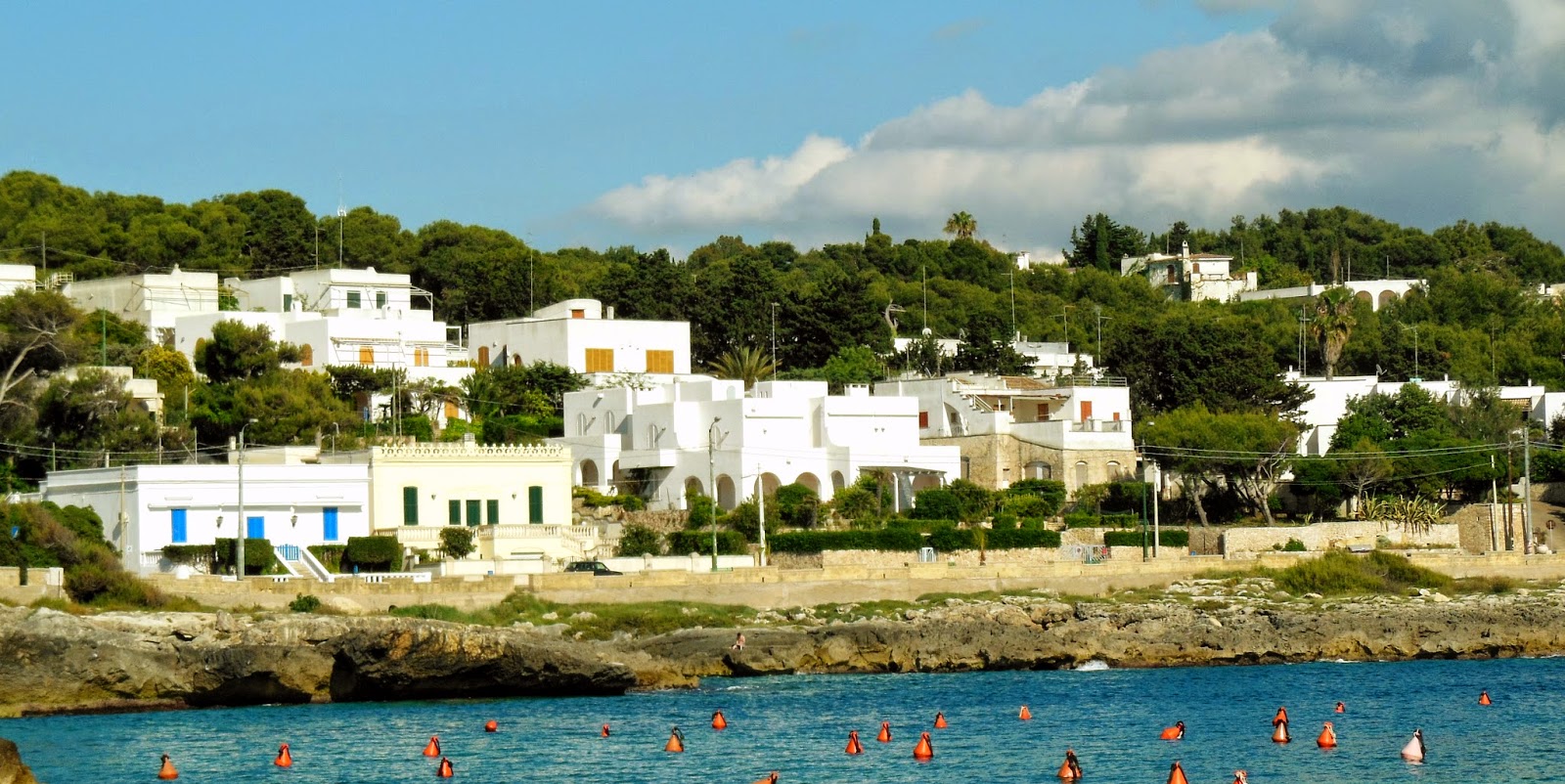
All along both the Ionian Sea and the Adriatic, beachfront communities glowed white in the sun and sand.  Carol ran into a minor bike problem, and we had to stop for a day to get repairs.


The placed we stopped was Otranto, a small city on the Adriatic that grew around a Spanish fortress built to protect its citizens from Turkish invasion. 


The town is a mix of Spanish and Greek styles. 


Walking around the old city, you get overwhelmed by the color white.  


So much so, that any bit of color really stands out.  


We thought you might enjoy the color contrasts.


And for the sixth time in this year’s travels, Carol got to wade in a different ocean or sea.


Friday, May 23, 2014

Hannibal’s Fortress


It feels good to be back in the saddle again.  Carol and Roger are riding along the south coast of Calabria.


Calabria is the southern-most part of the Italian peninsula.  The “toe” of the boot.


We started just outside the hectic city of Reggio Calabria and rode to Crotone….right along the Ionian Sea all the way.


Calabria is one of the poorest parts of Italy.  People make their livings by fishing…


 …or farming.


Much of the citrus Italians eat…oranges and lemons…come from Calabria.


The big energy companies have invested heavily in windmills that follow the shoreline to catch the sea breezes.


Calabria is supposed to be sunny virtually all year.  Our luck didn’t hold, but we were rewarded with a beautiful rainbow.


The highlight of our ride along the sole of the boot was the Fortress at Capo Rizzuto.

Legend has it that this was the place where Calypso hypnotized Odysseus and held him hostage for five years before he convinced Zeus to free him from the spell.  The fortress contains remnants of a wall built in the ancient Greek style.


The fortress itself was built by Hannibal, the great Carthaginian general during the Second Punic War, 218 to 202 BC.


After crossing the Alps with his elephants, he defeated the Roman army just south of the River Po.  Instead of driving toward Rome, Hannibal faked right and went left…marching down the Adriatic coast into Puglia (the “heel” of the Italian boot) and on to Calabria.  Fearing the Roman army would  at attack his rear, he built this fortress in 208 BC.

Over the centuries, the fortress slowly fell into disrepair, until 1494.  By this point, Calabria was ruled by the Spanish as part of the Kingdom of the Two Sicilys.  King Ferdinand, fearing invasion by the Ottoman Turks, built a series of forts along the Ionian and Southern Adriatic coasts, one very 5-15km.  Right around Capo Rizzuto, there were seven forts built on islands.  The other six island forts sank into the sea.  Only this one remains.


The towers apparently prevented the Turks from staging a full-fledged invasion.  


Instead, the Turks settled for a series of raids up and down the coast.  The worst was in Otranto on the Adriatic…where 800 civilians were butchered in one day when they refused to give up their Christian faith and convert to Islam.


Saturday, May 17, 2014

Sicilians: They’re Different

Our friends in Tuscany warned us, “Sicilians are different.”


Back in the States, we tend to think of Sicilians when we think of Italian-Americans.  That’s probably because so many of the Italians who emigrated to the US came from Sicily.  Names familiar to Americans, like Pinella and Paterno, are towns we drove through while visiting Sicily.


Sicilians are different.  In an opinion poll taken a few years back, when asked their nationality, a majority of Sicilians answered, “Sicilian,” not Italian.  

Carol, whose Italian has gotten pretty good with practice, could barely understand those who spoke to her in dialect.  She finds books written in the Sicilian dialect incomprehensible.


Sicily is a land of contrasts, both the scenery and the people.


You can see neat and prosperous farms tucked into lush hillsides…


…while just a few miles away, the hard-scrabble rock makes you wonder how anybody could scratch out a living there.


Sicily sits at the crossroads of the Mediterranean.  Consequently, it’s been invaded and conquered time and again.


The Carthaginians were first, founding what became Palermo and establishing several colonies on the west coast.


In the 8th century BC, the Greeks colonized the south and east coasts of the island.


A few centuries later, the Romans conquered Sicily, and it became the breadbasket of the Empire.


As the Roman Empire crumbled, the Moors came from North Africa.


On their way to the First Crusade, the Normans under King Ruggero took a detour and conquered Sicily... 


...leaving a scattering of Norman castles around the island, which otherwise would look out of place.


Next came the Spaniards, who established the Kingdom of the Two Sicilies, and drove the thriving Jewish community of Siracusa into exile.


Napoleon’s troops came next.  After conquering Sicily, the Emperor kidnapped a group of skilled artisans and sent them to Paris…but that’s the subject of an upcoming blog post.


In World War II, General George Patton came from North Africa and raced Montgomery’s British Army across the island on the way to Rome.


And today, the invasions continue.  This time it’s Africans, who over-crowd rickety beat-up boats to cross the Mediterranean and enter Europe illegally in search of a better life (a story Floridians would find familiar).  Just last October a boat-load of African illegals overturned off the coast of Sicily.  Two-hundred ninety-four bodies washed up on the beach at Lampedusa.  Others may never have been found.

Mt. Etna, the volcano, venting


Disasters are nothing new to Sicily.  In 1693, an earthquake struck eastern Sicily, killing perhaps as many as 200,000 people (estimates vary widely).  The destruction was widespread and thorough…


…which is why most of the “old” buildings on the island  were built after the earthquake in the Baroque style.


With all the different cultures that have ruled Sicily, it’s no surprise the system of  land ownership and tenant farming that evolved from the middle ages was complex and regressive. 


A small number of families controlled most of the land and lived lives of extravagant wealth…


…while the vast majority of people remained simple peasants.  There was little incentive to work to create more wealth, since most of the profit went to the landowners.  No wonder so many people emigrated to the US and Canada!


In the same way, the Sicilian legal system was corrupt…rigged in favor of the landowners.  Common people did everything they could to avoid getting entangled in a process in which they were almost guaranteed to lose.  So there evolved an extra-legal system to settle disputes between commoners.  Certain families became arbiters of disputes, taking a little payment from all concerned to make sure nobody violated the terms of the settlement.  These arbiters became known as mia famiglia, or “Mafia” for short.


Sicilians do not talk openly about the Mafia.  Most profess ignorance when asked about it by outsiders.  In some places, like the town of Corleone, tourists are strongly discouraged from taking photos, especially of residents.


In a seeming contradiction, T-shirts with this image are sold everywhere in Sicily.  Don Vito Corleone is not seen as an anti-hero…as he is in the United States.  Here, he’s seen as a full-fledged folk hero, somebody who emigrated to the US and made it to the big-time.


All of this brings us full-circle.  Carol and Roger went with Morris and Gail Rosenberg to the Palermo Opera House, Teatro Maximo, to pay homage to one of the greatest film sequences ever produced (Roger’s opinion)…the climax of Martin Scorcese’s Godfather III.