This is a glass of Barolo wine. Many consider it Italy's best wine (though Carol and Roger would argue that a good Brunello is every bit its match).
Barolo is one of four red wines grown in the Piemonte. The other three are Barbaresco, Barbera, and Dolcetto.
What distinguishes Barolo from the other three is the subject of this blog post.
Let's start with the color. Barolo wine is garnet in color. The others are a more traditional burgundy to purple in hue.
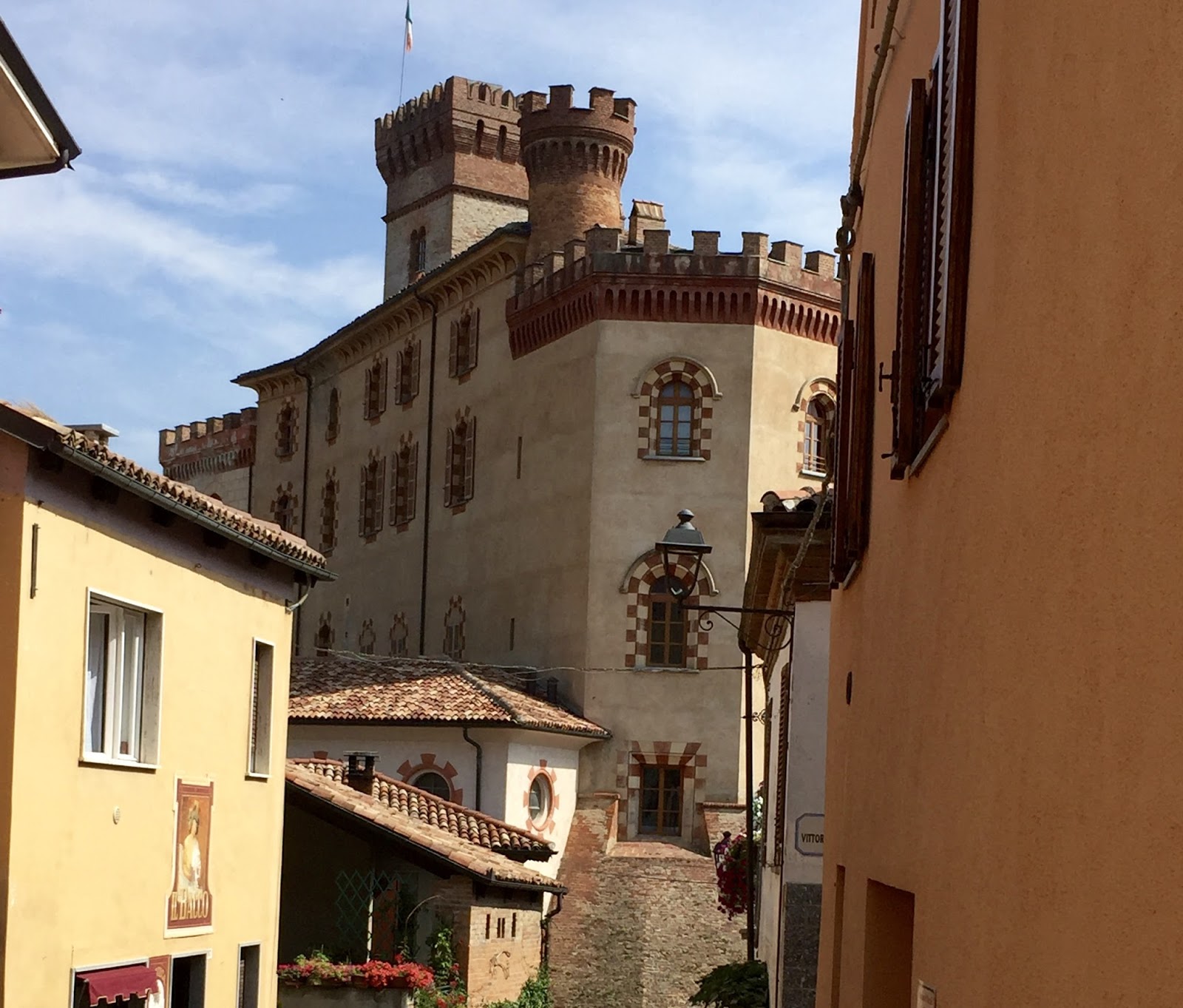
Barolo are grown on steep hillsides in 11 different comune (villages and surrounding countryside) roughly 70 km south of Torino, surrounding the town of...you guessed it...Barolo.
Barolo wine comes from the nebbiolo grape (as does Barbaresco, just to complicate things). Grapes for Barolo are the last harvested in the Piemonte...usually the first week in October.
In 1966, the Barolo winemakers association (Barolo DOCG) was formed. They established a comprehensive set of regulations defining what Barolo wine is:
- The vineyard must come from a well-defined "cru" list, currently comprising 4,285 acres.
- The vineyards must be on steep hillsides with no northern exposure allowed.
- Production must be limited to 3,000 bottles of wine per acre.
- Only nebbiola grapes are allowed. Alcohol content is high...a minimum of 13%.
- The wine must age at least 3 years, 18 months of it in oak barrels. Reservas must age 5 years.
There are 170 different wineries that are authorized to make Barolo. Because of the terrain, enologists (wine scientists) have identified more than 200 different micro-climates that can have a profound effect on the taste of the finished product.
We spoke to one wine-maker named Gianfranco who told us his winery has two nebbiolo vineyards side-by-side that produce distinctly different-tasting wine.
A bit of history here. The man at the right is Camillo Benso, the Count of Cavour and Italy's first prime minister.
Cavour was a master promoter. He spent his life promoting two things: Italian Unification and Barolo wine.
It was he who coined the phrase, "The king of wines and the wine of kings."
The woman at the left is Juliette Colbert, the French wife of the Marquis of Barolo. She was a contemporary of Cavour and brought French wine-making techniques to Barolo. Before she worked her magic, Barolo wine was totally unpredictable... ranging anywhere from undrinkable to sublime.
One wine magazine described today's Barolo vintners as "small scale family wineries with a focus on quality that borders on obsession."
Yet, even today, there are significant differences in the taste of Barolo,
The comune of La Morra sits perched on a very high hill west of the town of Barolo. It produces ⅓ of all Barolo wine. The soil is rich in lime, yielding a wine experts call "perfumed and velvety."
It matures to its best flavor 8 to 10 years after the grapes are harvested.
Across the valley from La Morra, perched on another hill sits Castiglione Falletto. In the vineyards surrounding this town, the soil is more sandy. The wine produced here is described as "austere and powerful."
It takes longer to mature to its best potential...sometimes as long as 15 years.
Up until the early 1970's, Barolo did not have the same reputation as a great wine that it has today.
Then, Barolo was always aged in large casks, longer than the 18 month minimum required by the DOCG.
There were some vintners who thought they could improve the wine by changing the way they made it.

They shortened the fermentation process. They aged the wine in smaller barrels and for a shorter time. They bottled the wine sooner and let it age in glass.
They liked the results they got...and so did the wine-drinking public. The traditionalists took note and worked hard to improve their product. They too succeeded.
So technique can add yet another dimension to the ways in which Barolos can differ in flavor.
(By the way, if you're interested, there's a 2014 film, "
The Barolo Boys" which documents the "war" between the traditionalists and the revolutionaries.)

Location, soil, microclimates, technique...Carol and Roger were simply befuddled. There was simply too much to understand.
We headed to the epicenter of winemaking, the town of Barolo, where there is a wine museum and
the Barolo Enoteca.
Perhaps they could help.
The enoteca has 200 different Barolo labels for sale...

...and 32 different Barolos to taste.
Agggh! We needed some help.

We finally found it at "La Terrazza del Barolo" in the person of Enzio.
Full disclosure: La Terrazza del Barolo is the community wine cellar for the comune of Castiglione Falletto. Their job is to promote (and sell) the wine produced in their comune.
Enzio walked Carol and Roger
ever so slowly through the subtleties in the commune's different wines...
...big barrels vs little barrels...
...two wines from the same hill, one near the top the other near the bottom...
...current vintage vs wines aged a few years longer...

We finally began to understand.
There was just one problem:
After so many glasses of wine, it was impossible to
remember any of it.
How expensive is a really good Barolo? We checked several wine magazines and found an article entitled "Italy's Most Expensive Wines." At the top of the list was Giacomo Conterno's Monforte Barolo Reserva...produced by a winery down a dirt road a short walk from our apartment. His reservas
averaged $755 a bottle...with the 2004 vintage going for $876.
Now, several days later, as we write this blog and try to figure out how to buy Barolos, two things stand out:
1) It's the dirt.
2) Older Barolos taste better than younger ones. (The problem, of course, is tasting a young wine and trying to figure out how it will taste in 5 to 10 years.)
- - - - - - - - - - - - - - - - - - - - - - - - - - - - - - - - - - - - - - - - - - - - - - - - - - - - - - - - - - - -
Afterword: At a food shop in Alba, Roger found a book entitled
Wine and Food. The last chapter was titled "
Rules for Pairing Wine with Food."
First came the French rules...11 different edicts filling two pages. It included things like
"Never serve
this wine with
this meat..."
"Each course should be paired with a different wine..."
"Always serve sparkling wines before still wines..."
"Never serve a more robust wine before one that is less so..."
Then came the Italian rules. It said simply, "Drink what tastes good."