Wednesday, November 13, 2013

Orvieto Tufa


The history of Orvieto is shaped by a volcanic rock called tufa.  Tufa is a soft rock deposited in the valley a hundred thousand years ago after a volcanic explosion.  Erosion has cut away all the surrounding rock, leaving a bluff hundreds of meters high...the perch upon which Orvieto sits.


People have lived atop this butte for thousands of years.  The town has a rich pre-history as an Etruscan settlement.  Walking down the road from the hilltop to the train station, we passed one of the archeological excavations.  The artifacts from that excavation are stored in the national archeological museum in the heart of town.


The museum is filled with pots and vases discovered in hundreds of Etruscan tombs.

The oldest are dated to the 6th century BCE.


The old city is divided into four quarters.  The main intersection, where via Duomo crosses Corso Cavour...


...is where the four quarters of the city meet.  (The rectangular white plaques on the corners of the buildings mark the boundaries of the quarters)


During the middle ages, this was important because the four quarters engaged in a decades-long civil war between the Guelphs (supporters of the Holy Roman Empire) and the Ghibellines (supporters of the pope).

The conflict decimated the population of the city.  The Ghibellines finally prevailed, and Umbria became one of the first Papal States.

Fast-forward a few hundred years to 1527.  The Holy Roman Empire under Charles V sacks Rome and chases Pope Clement VII out of the Vatican.  


Pope Clement flees to Orvieto for refuge.  He fears the Emperor’s army will follow and lay siege to the city.  Since Orvieto sits high on a bluff, any siege would cut off the city’s water supply.  His solution:  dig a hole down to the water table, and create a well to help the city withstand a siege.


The result was an engineering marvel of its age... Pozzo di S. Patrizio.

It took 10 years to dig the well.  Pope Clement did not live to see it finished.  The well has two spiral stairways, one atop the other, so that a man and his mule could descend to the bottom of the well while another man and his mule could use the other stairway to bring water up to the town.


Believe us, the well is really deep.  Had the rock beneath the city not been tufa, there’s no way 16th century technology could have finished this job in just 10 years.


Fast forward another two centuries.  The city has been re-populated and is running out of space.  The locals come up with a solution...

The Orvieto Underground....


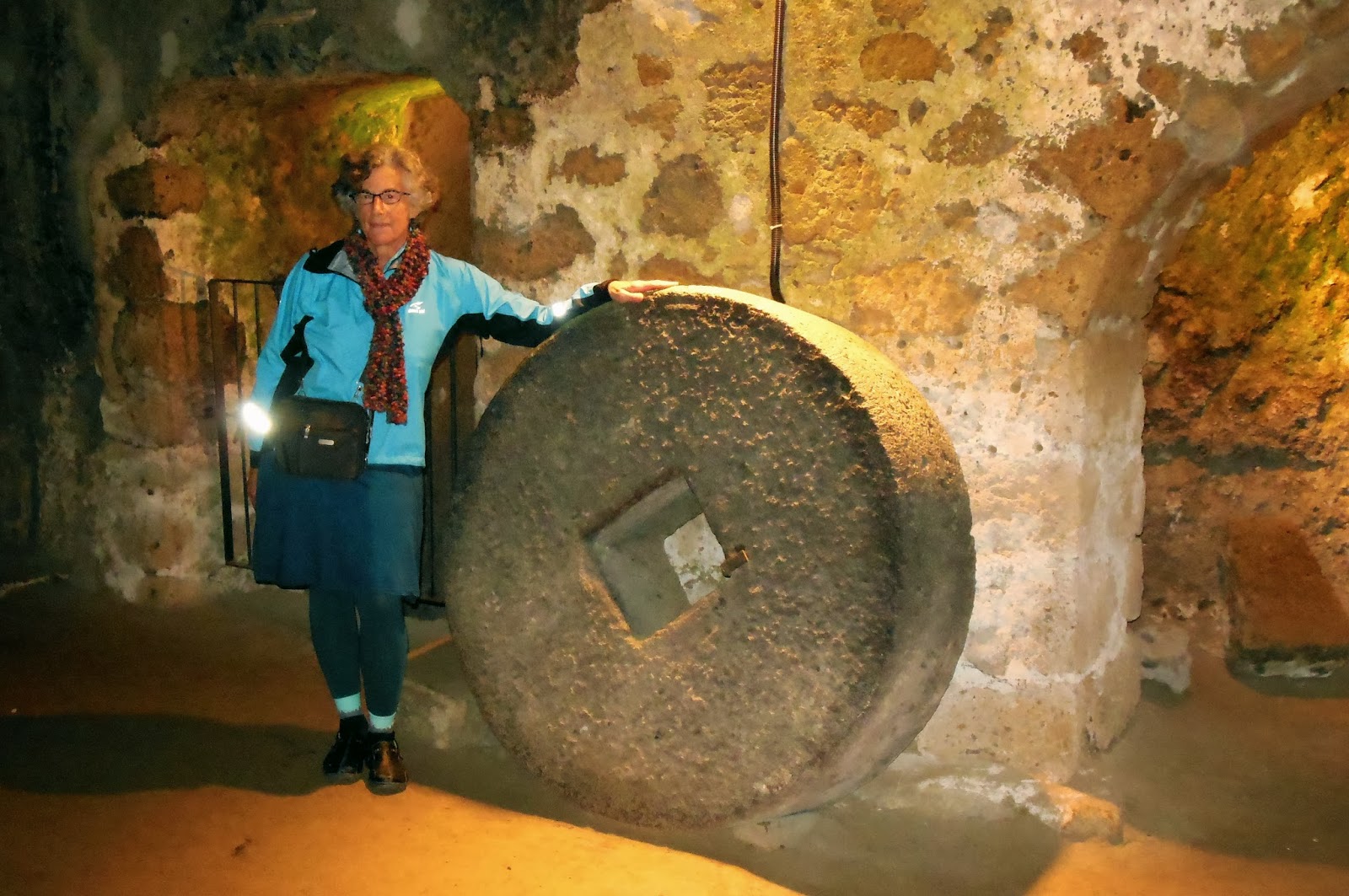
Caves...twelve hundred of them...dug in the tufa to create work space beneath people’s homes.  In many cases, the caves were used as pigeon coops to breed the birds for food.  


In the case of this particular cave, the space was used to press olive oil.


...which, as it turns out, will be the subject of our next blog post.


Monday, November 11, 2013

Regional Differences

Carol wanted to see Orvieto, the second largest city in Umbria, so we hopped on a train and went there.  

It is less than 50 miles away from our home in Pienza but in a different region of Italy.  We weren’t prepared for the differences we saw, but it was a reminder of how the mountainous geography and fractious political history created regional differences far greater than anything we have in the states.

What did we see in a short, two-day visit?

First the architecture.


Pienza: note the shapes and colors


Orvieto...note how the colors differ from Pienza.


The shapes of the buildings are different.


Montalcino's famous clock tower...


...and Orvieto's equally famous San Andrea Bell Tower


And the courtyards of the palazzi have a different aesthetic.

        Pienza's Piccolomini Palace


Orvieto Palace


The differences in artistic taste are clearly seen in each region's ceramica...

Tuscan platter with traditional Etruscian design.


The whites, yellows, and browns are typical of traditional Umbrian ceramics.


Each region's political history highlights these same differences.  In the middle ages, Central Italy was torn apart by a civil war that lasted more than 300 years.


On one side were the Ghibellines, who supported the Pope's right to political rule.  

Most of Umbria was in this camp.


On the other side were the Guelphs, who opposed the Pope as a political ruler.

Most of Tuscany was in this camp.


The food too is different.


Tuscany is famous for its red wine....


...while Umbria is famous for its white.


In Tuscany, this pasta is known as pici and is usually made with eggs...

...In Umbria, it’s known as Unbrichelli and is never made with  eggs.


In a Tuscan, this veal steak would not come with a green sauce...

Umbria is called the “green heart of Italy” and is famous for its vegetables.  Therefore, in Orvieto the artichoke sauce makes perfect sense on this slab of grilled veal.


In Tuscany, faraona (guinea hen) is a common form of restaurant fowl.  In Orvieto, it's piccione (pigeon).

In our next post, we'll show you how rock shaped Orvieto's history and made it the tourist destination it is.


Tuesday, November 5, 2013

Pienza's Hidden Treasures

Pienza and its environs are known for several things:  Pecorino di Pienza (sheep’s-milk cheese), wine, and olive oil.  They’re noted in every tourist guidebook.  But there are many other thingsjust as interesting...the guidebooks overlook.

Sunrise over the Val d'Orcia
Autumn mornings, the Val d’Orcia is often blanketed with fog.  


pretty to look at but very dangerous to cycle in.


Many of these treasures are tucked away down strade bianche (the gravel roads) that dot the countryside.


Or the strade verde...a whole network of well-marked hiking trails .  They are heavily used and connect small towns with 8-12km of walking between each stop.  We have walked on one, from Pienza to its rival town, San Quirico.   The trails skirt fields of crete ( huge clumps of the famous local clay soil), vineyards and olive orchards.  There are flowers, birds and other sights, depending upon the time of year.  We have met a number of people on self-guided walking tours and they are enthusiastic about their mode of transport as we are about cycling in the area.  Add to the mix, drivers who love the curvy roads and just about everyone is happy.


What are some of these treasures?


The beekeeper who makes miele castagna chestnut honey.


Or the chianina (white cows) used to make Flortenine steaks...which put the best Angus beef back home to shame.

 And their calves, who are butchered to make Vitello Bianco (white veal).


Sometimes, it’s just what you see along the side of the road

Spider web wet with morning dew
Last butterfly of the season


- - - - - - - - - - - - - - - - - - - - - - - - - - - - - - - -

The town the tour books forgot:  Montecchiello.  It’s on the next big hill south of Pienza.


You enter the quiet cobbled streets through the Porte Leone (Lion’s Gate).  

There are no distinctive products, like Pienza’s cheese.  

No special history.


Just a medieval walled town with quiet garden paths...


...perched high on a hill...


...free of tourists hordes and motorized traffic.  


It’s a great place to take a 600 year step back in time.


In another town nearby, we discovered a restaurant, 13 Gobbi (13 Hunchbacks), where the specialty of the house is worth every bit of the cholesterol overdose it provides.


It’s home-made tagliatelli, cooked in a cream sauce, and then poured, piping-hot, into a partially hollowed-out wheel of pecorino di Pienza.


The hot pasta melts the cheese in the wheel.

The cook scrapes more of the cheese into the mix

adds a bit of black pepper

and voila!clogged arteries

but ooh so good.


This part of Toscana is noted for its ceramica (pottery)traditionally with Etruscan ornamentation.


But in the same town as the restaurant, there are a pair of ceramic artists tucked away in a small laboratorio (workshop) who have put a different twist on tradition.


Massimo Lippi hand-paints a wide variety of traditional and modern designs.


some of them very intricate.


While his work-mate Mariella Spinelli created place-settings of dishes Carol just couldn’t resist. 


- - - - - - - - - - - - - - - - - - - - - - - - - - - - - - - - - - - - - - - - - - - - - - -
The conventional wisdom is foreign tourists who have fallen in love with the area have driven the price of real estate sky-high.  Despite this, if you look hard enough, you can still find a good deal on real estate.


OK, so it needs a little work.


Saturday, November 2, 2013

Festa di Castagna


November 2nd was a big day in PienzaLa Festa di CastagnaThe Chestnut Festival.  


The chestnuts have been falling off their trees for a few weeks now.  Last week, another town across the Val d’Orcia had its chestnut festa.  Today was Pienza’s turn.

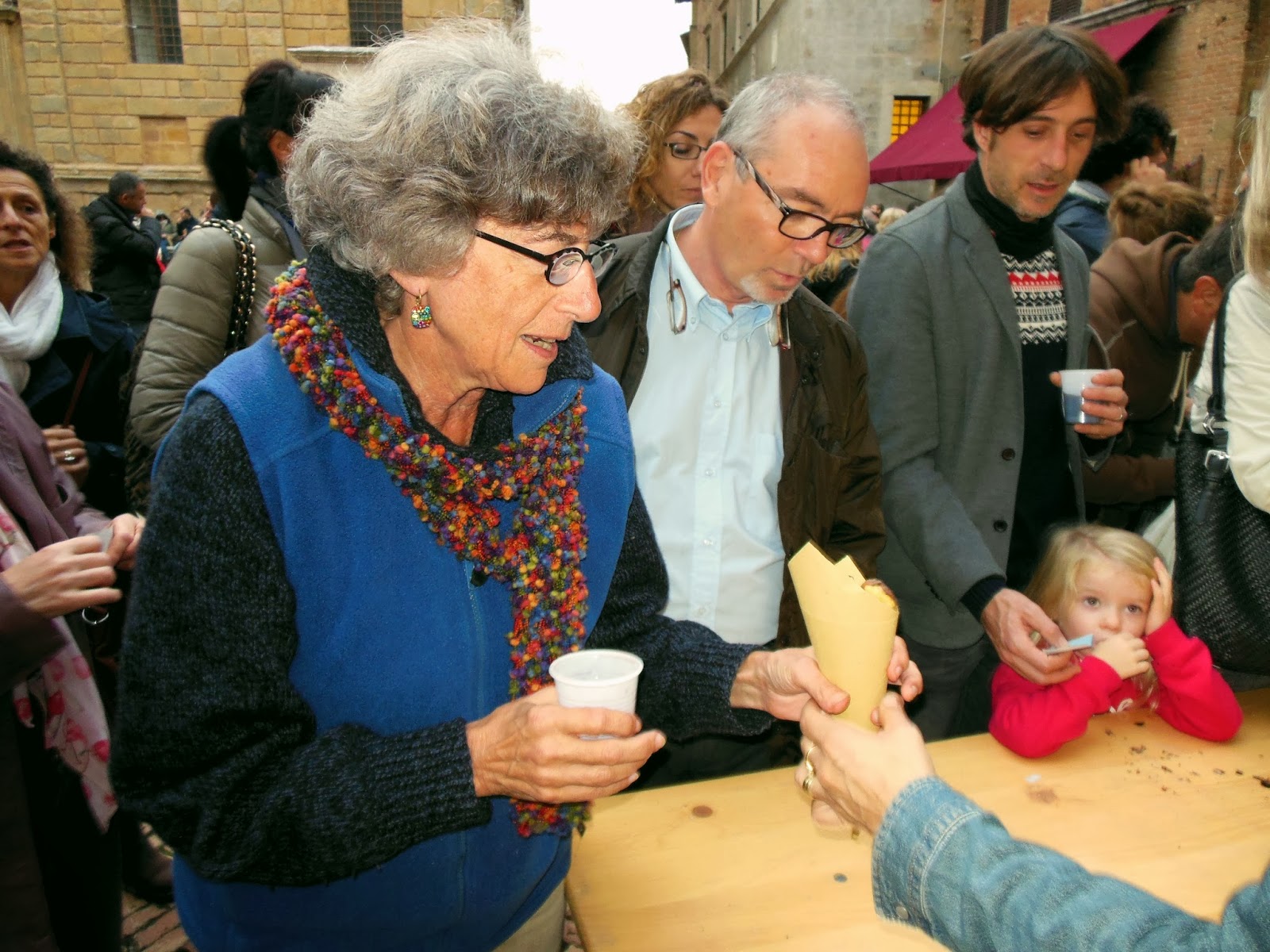
Hundreds of people stood in line for up to an hour, sipping mulled spiced wine while the roasters went to work.


The first task is to get the fire good and hot.


Scoop the chestnuts up to feed the roaster.


Tumble them in the roaster for about 15 minutes.


When the shells crack, dump them out of the roaster.


Package them up for sale.


Find a willing customer.....

No problem, there were hundreds.


Shuck the shells and enjoy.